How to Play Blackjack: Rules, Moves and Basic Strategy
How to play blackjack step by step: card values, hit, stand, double and split, why insurance is poor value, 3:2 payouts and how live blackjack tables work.
In this guide
- How do you play blackjack?
- Blackjack card values
- How is a round of blackjack dealt?
- What are hit, stand, double and split?
- What is insurance in blackjack, and should you take it?
- Dealer rules vary by table
- Blackjack payouts
- What is basic strategy in blackjack?
- Live blackjack: seats and bet behind
- Good habits at the blackjack table
- Take a seat
To play blackjack, you try to finish closer to 21 than the dealer without going over. Cards 2 to 10 count at face value, Jacks, Queens and Kings count 10, and an Ace counts 1 or 11. You get two cards, then choose to hit, stand, double or split. This guide shows how to play blackjack step by step, the moves worth knowing, why insurance is poor value and how live blackjack tables work.
How do you play blackjack?
Each player plays only against the dealer. You bet, receive two cards and decide whether to take more. If your total goes over 21, you bust and lose straight away. Once every player has finished, the dealer plays by fixed rules. If the dealer busts, or your total beats the dealer’s, you win.
Blackjack card values
| Cards | Value |
|---|---|
| 2 to 10 | Face value |
| Jack, Queen, King | 10 |
| Ace | 1 or 11, whichever helps your hand |
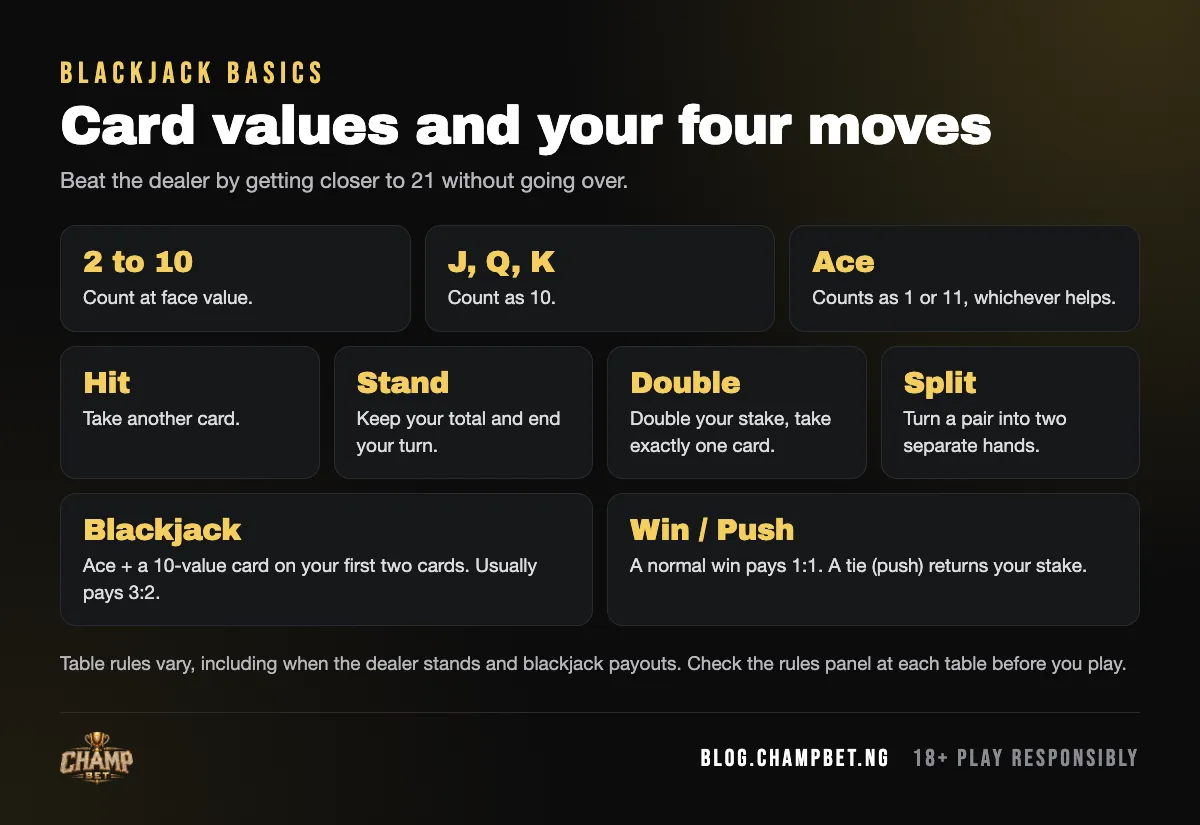 Card values, the main moves and the standard payouts on one card.
A hand with an Ace counted as 11 is called soft. Ace and 6 is soft 17: one more card cannot bust it, because the Ace drops to 1 if needed. A hand with no Ace, or with an Ace that must count as 1, is hard. Hard 16 busts on any card worth 6 or more.
A blackjack, also called a natural, is an Ace plus a 10-value card as your first two cards. It beats any other 21.
How is a round of blackjack dealt?
- Bet. Place your stake before the betting timer closes.
- Deal. Each player gets two cards face up. The dealer gets one card face up. Depending on the table, the dealer’s second card is dealt face down at once or after the players finish.
- Your turn. Hit, stand, double or split, following the order of the seats or, on many live tables, all at once.
- The dealer’s turn. The dealer reveals the second card and draws by the table’s fixed rule.
- Settlement. Wins are paid, pushes return your stake and losing bets are taken.
What are hit, stand, double and split?
These are the four decisions you make on your hand. Hit takes another card. Stand keeps your total. Double doubles your stake in exchange for exactly one more card. Split turns a pair into two separate hands with a second stake of the same size. Some tables add surrender, which returns part of your stake if you give up the hand.
| Move | What happens | Typical use |
|---|---|---|
| Hit | You take one more card. You can hit again. | Low totals, or 12 to 16 against a strong dealer card |
| Stand | You keep your total and end your turn. | 17 or more, or a stiff hand against a weak dealer card |
| Double | Your stake doubles and you get exactly one card. | 10 or 11 when the dealer’s card is weaker |
| Split | A pair becomes two hands, each with its own stake. | Aces and 8s |
Two details catch new players. When you split Aces, each Ace usually receives only one card. And an Ace plus a 10 after a split counts as 21, not as a blackjack, so it pays 1:1.
What is insurance in blackjack, and should you take it?
Insurance is a side bet offered when the dealer’s face-up card is an Ace. You bet up to half your stake that the dealer’s other card is worth 10, giving the dealer blackjack. It pays 2:1. It sounds like protection, but the price is wrong, so over time it loses money.
Here is why. In a full shoe, 4 out of every 13 cards are worth 10 (10, Jack, Queen, King). So the dealer completes a blackjack roughly 31% of the time. A bet that pays 2:1 needs to win more than one time in three, about 33%, just to break even. Insurance wins less often than that.
| Situation | Insurance bet | Result |
|---|---|---|
| Dealer has blackjack | ₦500 | You win ₦1,000 on insurance, lose your ₦1,000 hand (unless you also have blackjack) |
| Dealer does not | ₦500 | You lose the ₦500 and play the hand as normal |
PlaySmart, the responsible gambling site of Ontario’s lottery corporation, describes insurance as a separate side bet paying 2:1 when the dealer shows an Ace. If you have blackjack yourself, “even money” is the same bet with a different name.
Dealer rules vary by table
The dealer has no choices. In the standard game, the dealer must hit on 16 or less and stand on 17 or more. The details change between tables, and they shift the house edge. Read the help screen before you sit.
- Soft 17. Some tables make the dealer hit soft 17. Standing on it is better for you.
- Number of decks. Most live tables deal from a shoe of several decks.
- Doubling. Some tables allow a double on any two cards, others only on 9, 10 or 11.
- Splitting. Rules on re-splitting and doubling after a split vary.
- Blackjack payout. 3:2 is standard. A table paying 6:5 gives only ₦1,200 on a ₦1,000 blackjack instead of ₦1,500.
Blackjack payouts
| Result | Pays | ₦1,000 stake |
|---|---|---|
| Win | 1:1 | Win ₦1,000 plus your stake back |
| Blackjack | 3:2 (typical) | Win ₦1,500 plus your stake back |
| Push (tie) | Stake returned | Get ₦1,000 back |
| Insurance win | 2:1 on the insurance bet | ₦500 insurance wins ₦1,000 |
| Lose or bust | Stake lost | Lose ₦1,000 |
What is basic strategy in blackjack?
Basic strategy is the best decision for every combination of your hand and the dealer’s face-up card, worked out by computer over millions of hands. It does not beat the house, but it cuts the edge to its lowest point. PlaySmart says correct play can bring blackjack’s house edge to about 0.5%.
Full charts depend on the table rules, but the core ideas for a standard multi-deck game are simple:
- Hard 17 or more: stand.
- Hard 13 to 16: stand if the dealer shows 2 to 6, hit if the dealer shows 7 to Ace.
- Hard 12: stand against 4 to 6, otherwise hit.
- 11: double against most dealer cards.
- 10: double against 2 to 9.
- Pairs: always split Aces and 8s. Never split 10s or 5s.
- Insurance: skip it.
The reason behind most of it: the dealer showing 2 to 6 is more likely to bust, so you let the dealer take the risk. Against 7 to Ace, the dealer usually ends on 17 or more, so you need to improve your hand.
Live blackjack: seats and bet behind
A classic live blackjack table has seven seats. Evolution explains on its live blackjack page that when every seat is taken, you can bet behind a seated player instead. Your bet follows that player’s hand: you win when they win and lose when they lose, but you make no decisions. You can also bet behind other hands while you hold a seat.
Each player has a decision timer, so do not leave the table mid-hand. Some live games also let every seat make its first decision at the same time, which speeds rounds up.
FreeBet BlackJack at ChampBet
The ChampBet live casino includes FreeBet BlackJack tables from CREEDROOMZ. According to the CREEDROOMZ game page, you get a free double down on hands totalling 9, 10 or 11, and free splits on all pairs except 10s, Jacks, Queens and Kings. The house puts up the extra stake on those free bets.
The same page lists a Cashout feature that lets you surrender a hand at any point for a partial return, and an optional Progressive Blackjackpot side bet. The ChampBet mobile lobby shows a Blackjackpot panel with Gold, Silver and Bronze pots. A variant can differ from classic blackjack in other rules too, so read the table’s help screen before you play.
Good habits at the blackjack table
- Set a budget and a stake size before you sit. Our bankroll management guide shows a simple method.
- Ignore “hot” dealers. The cards decide each hand, not the person dealing them.
- Never chase losses by raising your stake to win back a bad run.
- Learn the edge behind every game in our guide to RTP and house edge.
Take a seat
Open the Blackjack tab of the ChampBet live casino to find a seat, FreeBet BlackJack included. Live blackjack counts towards the Daily Live Casino Cash Rebate, full terms apply. Read how live casino works for the basics of live tables, or try how to play baccarat for a card game with no decisions at all. Questions about your account go to the ChampBet casino help page.
Frequently asked questions
What is the goal in blackjack?
The goal is to beat the dealer's hand without going over 21. You win if your total is higher than the dealer's, or if the dealer busts while you are still in. You do not need exactly 21, and you are not playing against the other players at the table.
How much does blackjack pay?
A normal win pays 1:1, so a ₦1,000 bet wins ₦1,000. A blackjack, meaning an Ace and a 10-value card as your first two cards, typically pays 3:2, so ₦1,000 wins ₦1,500. A tie with the dealer is a push and your stake comes back. Check each table's paytable.
Should I take insurance in blackjack?
Usually no. Insurance is a side bet that the dealer's next card is worth 10 when the dealer shows an Ace. It pays 2:1, but only about 4 cards in 13 are worth 10, which is less often than that price needs. Over time it costs you money.
What does bet behind mean in live blackjack?
Bet behind lets you bet on a seated player's hand at a live table. You win or lose with that player's result, but the seated player makes the decisions. It lets you join a full seven-seat table, or add a bet on another hand while you play your own.
What is FreeBet BlackJack?
FreeBet BlackJack is a CREEDROOMZ variant in the ChampBet live casino. You get a free double down on hands totalling 9, 10 or 11 and free splits on all pairs except 10s, Jacks, Queens and Kings, so the extra stake is not yours. Read the table's help screen for its full rules.