Betting Bankroll Management: How Much Should I Stake?
Betting bankroll management made simple: set a monthly budget, stake 1% to 5% per bet, choose flat or percentage staking, keep records, never chase losses.

In this guide
- What is a betting bankroll?
- How do you set a betting budget?
- How much should I stake per bet?
- What is unit staking?
- Flat staking vs percentage staking
- How do odds affect your stake?
- Keep a record of every bet
- Why you should never chase losses
- Use limits and tools
- Bonuses and cashback in your bankroll
- Bet within your plan
Betting bankroll management means deciding, before you place a single bet, how much money you will use for betting and how much each bet will risk. The short answer to “how much should I stake?” is 1% to 5% of your betting budget per bet, and never more than you can afford to lose. This guide shows how to set a budget, size your stakes, keep records and avoid chasing losses.
What is a betting bankroll?
A betting bankroll is the money you set aside only for betting. It is separate from rent, food, school fees, transport, data and savings, and it is an amount you could lose completely without it hurting your life. You decide it in advance, usually as a monthly figure, and you do not add to it when it runs low.
Thinking of it as a bankroll changes how you bet. Each stake becomes a small, planned part of a budget, not a reaction to the last result. It also gives you a clear stop point: when this month’s bankroll is gone, you are done until next month.
How do you set a betting budget?
Start from what you can spare, not from what you hope to win. Take your monthly income, remove every essential cost and the money you are saving, then decide what share of what is left you are happy to spend on entertainment. Your betting budget comes out of that entertainment share, alongside things like going out or match tickets.
Then follow two rules from ChampBet’s responsible gaming page: define the monthly amount you can spend beforehand, and once you set a maximum, do not increase it. Never borrow to bet, and never use money meant for bills.
How much should I stake per bet?
Stake between 1% and 5% of your bankroll on each bet. Use 1% for accas and long odds, around 2% for an ordinary single, and treat 5% as the absolute ceiling. Small stakes feel slow, but they let you survive the losing runs that every bettor hits, so one bad weekend does not end your month.
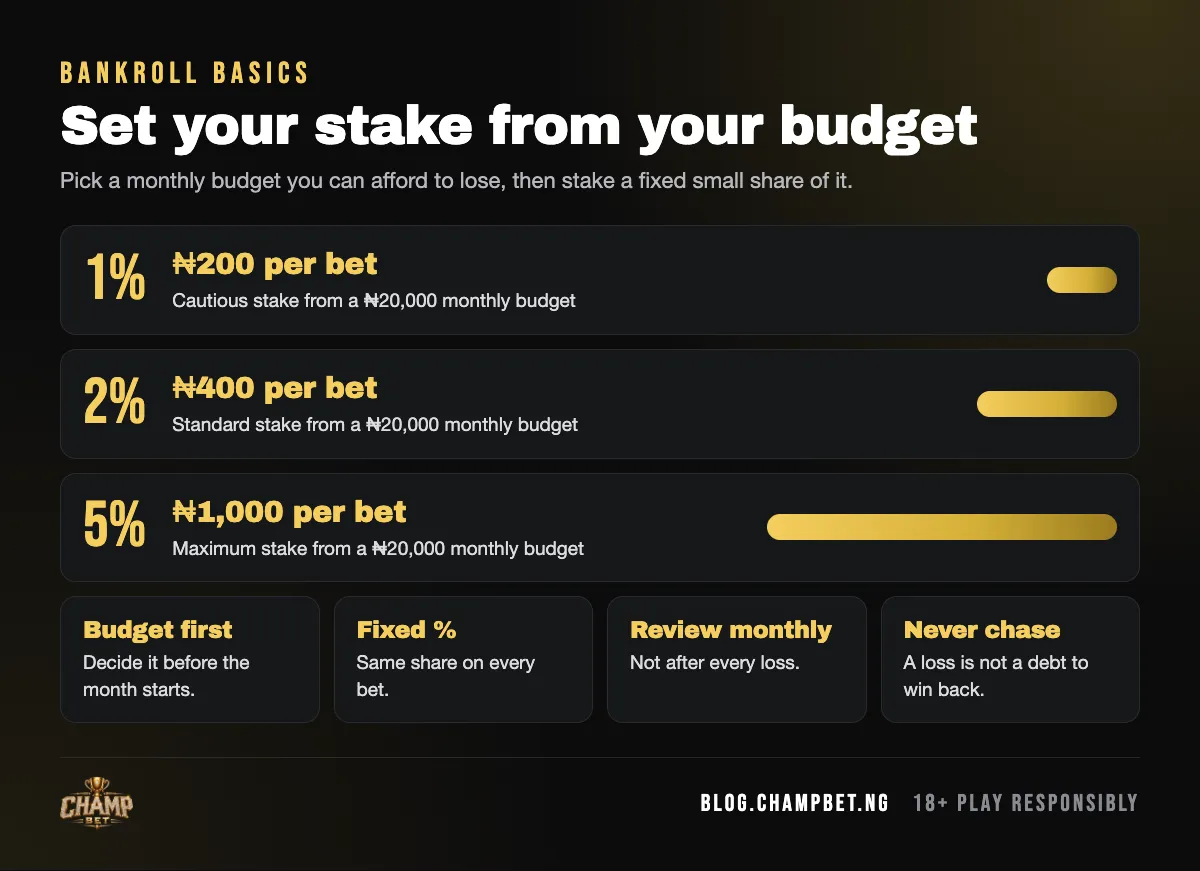 Set your stake from your budget, not from how confident you feel.
Here is what the same percentages look like for different budgets:
| Monthly budget | 1% stake | 2% stake | 5% stake |
|---|---|---|---|
| ₦10,000 | ₦100 | ₦200 | ₦500 |
| ₦20,000 | ₦200 | ₦400 | ₦1,000 |
| ₦50,000 | ₦500 | ₦1,000 | ₦2,500 |
| ₦100,000 | ₦1,000 | ₦2,000 | ₦5,000 |
Why small stakes matter
Losing runs are normal, even for good bettors. If you bet 100 times at odds of 2.00 on outcomes that truly win half the time, there is about an 80% chance you will hit five or more losses in a row somewhere along the way. Look at what that does to a ₦20,000 bankroll:
- At 5% flat (₦1,000 a bet): five straight losses cost ₦5,000. You still have ₦15,000.
- At 20% flat (₦4,000 a bet): five straight losses cost all ₦20,000.
The second bettor was not unlucky. Their stake size made the losing run fatal.
What is unit staking?
Unit staking means measuring bets in units instead of naira. One unit is a fixed share of your bankroll, usually 1% or 2%. A standard bet is one unit, a stronger view might be two, and nothing goes above your ceiling. Units keep your stakes consistent and let you compare results across months, even when your budget changes.
With a ₦20,000 bankroll and a 2% unit, one unit is ₦400. A one-unit single at odds of 1.80 returns ₦720 if it wins. A long-odds acca might get half a unit, ₦200.
Flat staking vs percentage staking
There are two simple ways to keep stakes under control.
| Method | How it works | Good for | Watch out for |
|---|---|---|---|
| Flat staking | The same naira stake on every bet, set from your starting bankroll | Beginners; easy to track | Stakes do not shrink after losses |
| Percentage staking | A fixed % of your current bankroll, recalculated each time | Protecting a shrinking bankroll | Requires a quick sum before each bet |
Flat staking example. Bankroll ₦20,000, flat stake 2% = ₦400 on every bet, win or lose, until the month resets.
Percentage staking example. Bankroll ₦20,000, stake 5% of what is left. After ten straight losses you would still have about ₦11,975, because each stake is 5% of a smaller balance. The bankroll bends but does not break.
Either method works. What does not work is doubling your stake after a loss to “get it back”. That is chasing, and it is the fastest way to empty a bankroll.
How do odds affect your stake?
The longer the odds, the smaller your stake should be. A single at 1.50 wins often, so a full unit is reasonable. A ten-leg acca might land rarely, so half a unit or less makes sense. Long-odds bets are fine for fun, but they should never take a big share of your budget.
Check whether the price is fair, too: our guide to value betting explained shows how to compare odds with your own estimate, and accumulator bets explained shows how fast extra legs cut your chance.
Keep a record of every bet
A simple record shows you the truth about your betting, not the version memory tells you. Use a notebook, a spreadsheet or the notes app on your phone.
| Date | Match and market | Odds | Stake | Result | Profit/loss |
|---|---|---|---|---|---|
| 04 Oct | Home win (single) | 1.80 | ₦400 | Won | +₦320 |
| 05 Oct | 3-leg acca | 3.20 | ₦200 | Lost | -₦200 |
Your ChampBet account also lists every accepted bet in Bet History, so you can check your log against it. At the end of each month, add up the total staked and the total profit or loss. If the losses are bigger than you planned, lower your budget for next month, not your standards.
Why you should never chase losses
Chasing losses means raising your stakes or betting more often to win back money you have lost. It feels logical in the moment, but each bet has the same chance as before, and bigger stakes only make the next loss hurt more. ChampBet’s responsible gaming page lists trying to win back lost money as one of the warning signs of problem gambling.
If you feel the urge to chase, stop for the day. Your budget resets next month, and the matches will still be there.
Use limits and tools
Tools make discipline easier, because you set them when you are calm. ChampBet’s terms provide for deposit limits, and its offer terms refer to time-outs and self-exclusion. To set one up, contact support on WhatsApp at +234 707 982 0431 or through the live chat on the site.
In Lagos, the Lagos State Lotteries and Gaming Authority also runs SAFEPLAY, a regulator-led self-exclusion platform that covers multiple licensed operators at once. For free advice and support, BeGambleAware has tools to check your habits, and our responsible gambling guide lists where to get help in Nigeria.
Bonuses and cashback in your bankroll
Treat bonus money as separate from your bankroll until it becomes withdrawable cash, because bonuses carry wagering rules. Cashback, such as ChampBet’s Weekly Sports Cashback paid as a free bet, softens a losing week but is not a plan to rely on. Our cashback guide explains how it works, and full terms apply.
Bet within your plan
Set your budget, pick your stake size and write both down before your next bet. Then read ChampBet’s responsible gaming tools and rules, and when you are ready, open the ChampBet sportsbook knowing exactly what each bet can cost.
Frequently asked questions
How much should I stake per bet?
A sensible range is 1% to 5% of your betting budget per bet. With a ₦20,000 monthly budget, that is ₦200 to ₦1,000 a bet. Use the lower end for accas and long odds, and never go above 5%, so a normal losing run cannot wipe out your budget.
What is a betting bankroll?
A betting bankroll is the money you set aside only for betting, separate from rent, food, school fees, transport and savings. It should be an amount you can afford to lose completely without it affecting your life. You decide it in advance, usually as a monthly figure, and do not top it up.
What is unit staking in betting?
Unit staking means measuring every bet in units instead of naira. One unit is a fixed share of your bankroll, usually 1% to 2%. A normal bet might be one unit and a stronger view two units. It keeps your stakes consistent and makes your results easy to compare over time.
Is flat staking or percentage staking better?
Flat staking, the same naira amount on every bet, is simplest and best for beginners. Percentage staking, a fixed share of your current bankroll, cuts your stake automatically after losses and raises it after wins. Both work if you stick to them. What fails is changing stakes on emotion.
How do I stop chasing losses?
Set your budget and stake size before you bet, and stop when the budget for the period is gone. Never raise a stake to win back a loss. Take a break after a losing run, and if you keep chasing, use a deposit limit, a time-out or self-exclusion and talk to someone.