Value Bet Meaning: How Value Betting Works, With Maths
What is a value bet? Implied probability, expected value and bookmaker margin explained with naira examples, plus the honest limits of value betting.

In this guide
A value bet is a bet where the odds pay more than the real chance of the outcome justifies. You find one by comparing two numbers: the implied probability in the odds and your own estimate of the chance. If your estimate is higher, the bet has positive expected value, which means it should make money on average over many bets.
That is the whole idea. The hard part, as this guide shows, is estimating the chance well and living with the swings. All odds below are examples, not live prices.
What is a value bet?
A value bet is one where your estimated probability of an outcome is higher than the probability implied by the odds. Odds of 2.50 imply a 40% chance. If you rate the outcome at 45%, those odds are generous by your view, so the bet has value. Value is about the price, not about whether the bet wins.
So a value bet is not “a likely winner”. A 1.20 favourite can be terrible value, and a 6.00 outsider can be good value. It all depends on whether the price is bigger than the chance deserves.
Implied probability vs your estimate
Implied probability is the chance the odds suggest. For decimal odds, divide 1 by the odds: 2.00 implies 50%, 2.50 implies 40%, 4.00 implies 25%. Your estimate is your own view of the real chance. Value exists only when your estimate is higher than the implied figure.
Our guide to how betting odds work covers implied probability in detail. Here it is in one table:
| Decimal odds | Implied probability | You need to rate it above |
|---|---|---|
| 1.40 | 71.4% | 71.4% |
| 2.00 | 50.0% | 50.0% |
| 2.50 | 40.0% | 40.0% |
| 3.20 | 31.3% | 31.3% |
| 5.00 | 20.0% | 20.0% |
You can also turn it around. Divide 1 by your estimate to get your “fair odds”. If you rate a team at 45%, your fair odds are 1 divided by 0.45, which is 2.22. Any price above 2.22 is value by your numbers. Any price below it is not.
How do you calculate expected value?
Expected value (EV) is the average profit or loss a bet would make per stake if you could place it many times. For decimal odds, multiply your estimated probability by the odds and subtract 1. A positive answer means value. A negative answer means the price is too short for your estimate.
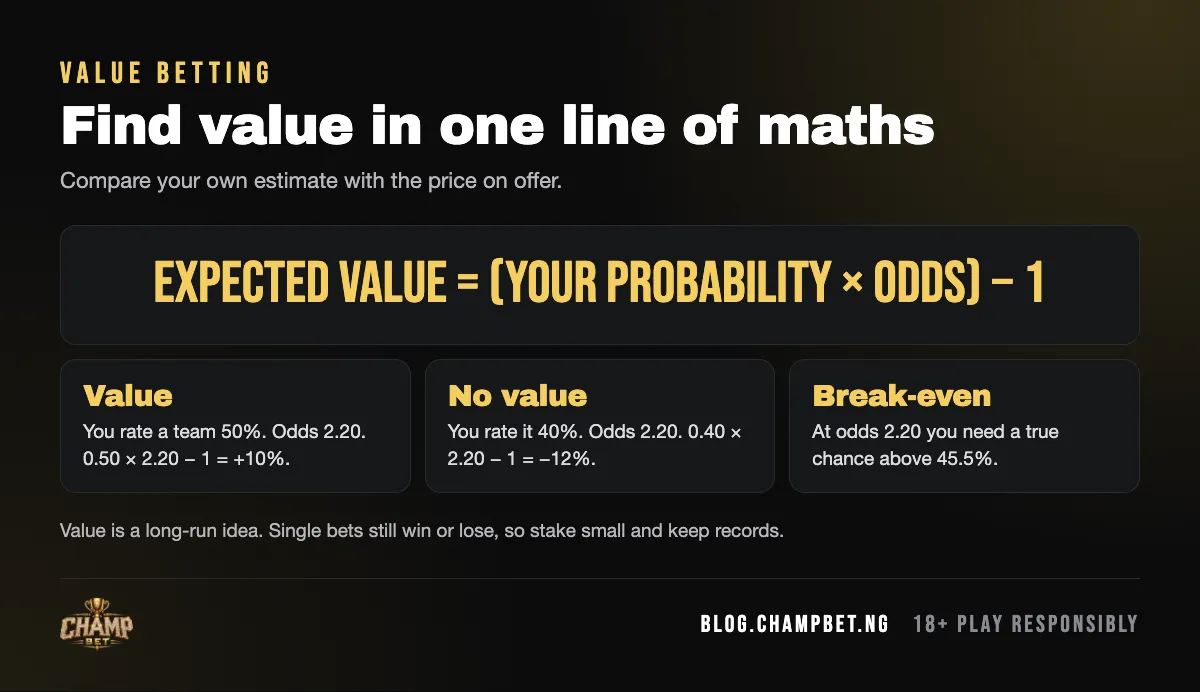
The two formulas, which give the same answer:
- EV per ₦1 staked = (your probability × odds) minus 1
- EV in naira = (probability of winning × profit) minus (probability of losing × stake)
Here are four ₦1,000 examples:
| Bet | Odds | Implied | Your estimate | EV on ₦1,000 |
|---|---|---|---|---|
| NPFL home win | 2.50 | 40.0% | 45% | +₦125 |
| Same bet, lower view | 2.50 | 40.0% | 35% | -₦125 |
| Strong favourite | 1.40 | 71.4% | 75% | +₦50 |
| Draw | 3.30 | 30.3% | 30% | -₦10 |
Take the first line. If the home side wins, you make ₦1,500 profit. If it does not, you lose ₦1,000. With a 45% chance: 0.45 × ₦1,500 = ₦675, minus 0.55 × ₦1,000 = ₦550, gives +₦125. That is a 12.5% edge, by your estimate.
The favourite line matters too. A 1.40 price will never pay much, but if it truly wins 75% of the time, it is a better bet than the draw at 3.30 that you rate exactly at its price.
How does the bookmaker margin affect value?
The bookmaker margin, or overround, is the reason value is hard to find. Add up the implied probabilities of every outcome in a market and you get more than 100%. The extra is the margin. It means most prices sit a little below fair odds, so a casual estimate usually lands on the wrong side of the line.
Here is an example 1X2 market:
| Outcome | Odds | Implied | Margin removed | Fair odds |
|---|---|---|---|---|
| Home | 2.30 | 43.5% | 41.4% | 2.42 |
| Draw | 3.30 | 30.3% | 28.9% | 3.47 |
| Away | 3.20 | 31.3% | 29.8% | 3.36 |
| Total | 105.0% | 100.0% |
The overround here is about 5%. If your estimates matched the fair figures exactly, every bet in this market would still have negative expected value of around 5%, because you are paid at 2.30 for an outcome worth 2.42. To find value, your estimate has to beat the implied 43.5%, not just the fair 41.4%.
Margins also stack in accumulators. Four legs with about a 5% margin each give a combined overround of roughly 1.05 × 1.05 × 1.05 × 1.05, which is about 22%. Our accumulator bets guide explains how acca odds multiply.
Why does value matter in the long run?
Value matters because expected value adds up over many bets, while luck evens out. One bet is close to a coin toss either way. Over hundreds of bets, your results drift towards your average edge. Bets with negative expected value drift the other way.
Say you place 200 bets of ₦1,000:
- At +5% EV, your expected result is +₦10,000.
- At -5% EV, your expected result is -₦10,000.
The stakes and the excitement are the same. The long-run direction is opposite. That is why the price you take matters as much as the team you pick.
The honest limits of value betting
Value betting is a sound idea with three hard limits: results swing wildly in the short run, your probability estimates can be wrong, and the margin works against you all the time. Anyone who presents it as a simple system is leaving those parts out.
Variance: even real value loses often
Take the first example: ₦1,000 at 2.50 on an outcome that truly wins 45% of the time. Over 100 bets the expected profit is ₦12,500. Yet the chance of finishing those 100 bets in a loss is about 13%, and the chance of not being in profit at all is about 18%. Losing runs are normal too. Over 100 such bets, you should expect a couple of runs of five or more losses in a row.
Over 500 bets, the chance of being down falls to about 1%. But that assumes your 45% was correct all along.
Estimating is hard
Your probability is an opinion, not a fact. Bookmakers price thousands of markets with data, models and the weight of money from many bettors. Beating them consistently is difficult, and most people overrate their own judgement, especially on teams they support.
A good test: if you cannot explain in one sentence why your number is better than the market’s, you probably do not have value.
Nobody can sell you certain value
Tipsters and groups that promise certain wins are not selling value. They are selling hope. Our guide to the truth about paid tips shows the warning signs.
How to look for value bets
Looking for value is a process, not a trick. Work out your own probability first, compare it with the odds, bet only when your number is clearly higher, and keep records so you learn whether your estimates are any good.
- Estimate before you look at the odds. Seeing the price first pulls your estimate towards it.
- Use data, not feelings. Form, injuries and underlying numbers such as expected goals (xG), explained by Opta’s The Analyst, help you judge how good a team really is.
- Specialise. You are more likely to beat the price in a league you follow closely, such as the NPFL, than across fifty leagues.
- Demand a margin of safety. Bet only when your estimate beats the implied probability by a clear gap, not by half a percent.
- Keep a record. Write down each bet, the odds and your estimate. After 100 bets you will see whether your numbers hold up.
- Stake small and flat. A fixed small share of your budget lets you survive the swings. See our bankroll management guide.
Finding prices on ChampBet
The ChampBet sportsbook shows decimal odds in W1 / X / W2, Handicap and Totals columns, so you can work out implied probabilities at a glance.
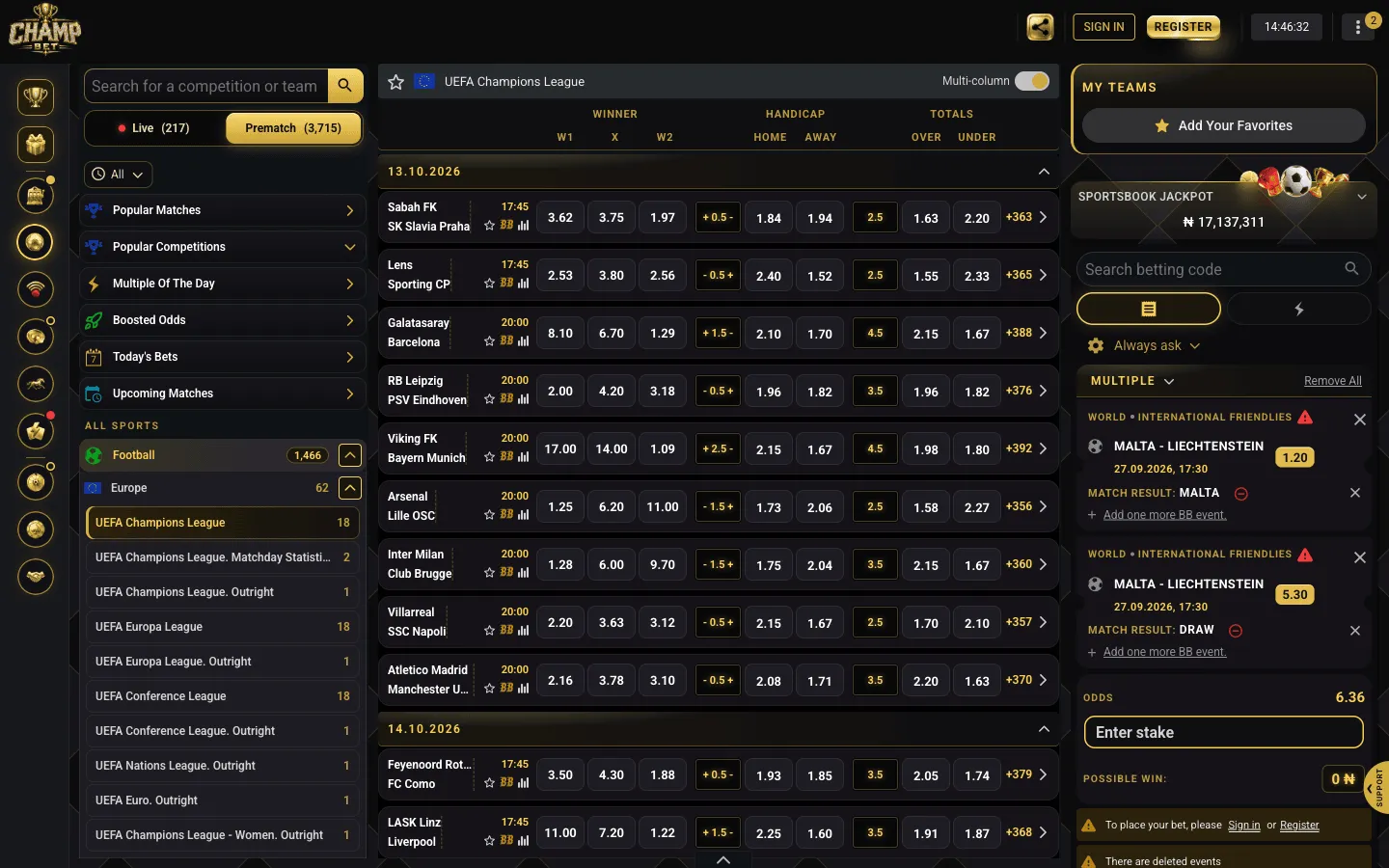 Decimal odds in the W1 / X / W2, Handicap and Totals columns. Divide 1 by any price to get its implied probability.
Prices move, so before you confirm, check the odds in the slip still match the price you calculated. The slip’s odds setting shows “Always ask”, which asks you before a changed price is accepted. Settlement rules for every market are in the ChampBet sports betting rules.
Put the maths to work
A value bet is simply a price that beats your honest estimate of the chance, and expected value tells you what that edge is worth over time. Start small: open the ChampBet pre-match markets, write down your own probability for a match, then compare it with the odds. For games already in play, the same maths works in live betting.
Frequently asked questions
What is a value bet?
A value bet is a bet where the odds pay more than the true chance of the outcome justifies. If you think a team has a 45% chance and the odds of 2.50 imply only 40%, the price is generous by your estimate, so the bet has positive expected value.
How do you calculate expected value in betting?
Multiply your estimated probability by the decimal odds and subtract 1. The answer is your expected profit per ₦1 staked. At odds of 2.50 with a 45% chance, 0.45 x 2.50 minus 1 equals 0.125, so a ₦1,000 stake has an expected value of +₦125.
Does value betting mean you will win?
No. Value is about the long-run average, not the next bet. A bet with positive expected value still loses often, and a run of 100 such bets can finish in a loss. Your estimate of the probability can also simply be wrong, which is the biggest risk of all.
Can a favourite be a value bet?
Yes. Value depends on the price, not on whether the team is the favourite. A favourite at 1.40 implies a 71.4% chance. If you rate it at 75%, the bet has positive expected value. An underdog can be poor value if its odds are too short.
How does the bookmaker margin affect value betting?
The margin makes the implied probabilities in a market add up to more than 100%, so most prices sit slightly below fair odds. To find value, your estimated probability has to beat the implied probability including the margin, not just the fair chance.