How Betting Odds Work: Decimal Odds, Implied Probability
How betting odds work in Nigeria: decimal odds, payouts, implied probability and the bookmaker margin, with clear tables so you can read any price fast.

In this guide
Betting odds tell you two things: how much a winning bet pays and how likely the bookmaker thinks the outcome is. In Nigeria, odds are shown in decimal format, so reading them is simple: multiply your stake by the odds to get your total return. This guide explains how betting odds work, from payouts to implied probability and the bookmaker margin.
All odds below are illustrations, not live prices.
What are decimal odds?
Decimal odds are a single number, such as 1.80 or 3.50, that shows your total return for every ₦1 you stake, including the stake itself. Odds of 1.80 return ₦1.80 for each ₦1, so ₦1,000 returns ₦1,800. The higher the number, the bigger the payout and the less likely the bookmaker thinks the outcome is.
A few terms you will hear:
- Odds-on: below 2.00. The bookmaker rates the outcome as more likely than not.
- Evens: exactly 2.00. A win doubles your stake.
- Odds-against: above 2.00. The outcome is rated less likely than not.
- Favourite and underdog: the shortest and the longest price in a match.
How do you calculate your payout?
To calculate a payout with decimal odds, multiply your stake by the odds. That figure is your total return, and it includes your stake. To find your profit, take the stake away from the return. So ₦2,000 at 1.75 returns ₦3,500, which is ₦1,500 profit on top of your ₦2,000 back.
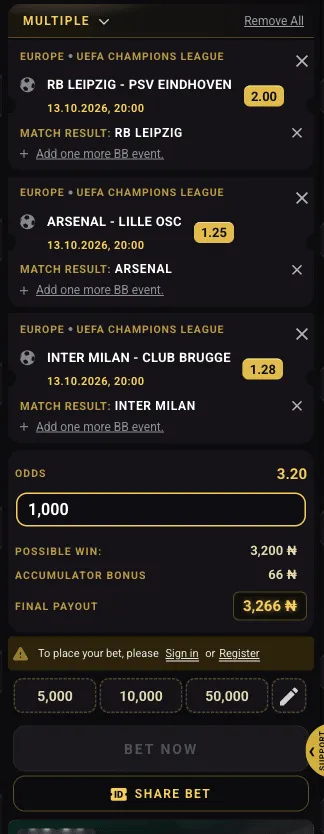
The ChampBet slip does the maths for you: stake × odds = possible win.
The two formulas:
- Total return = stake × odds
- Profit = stake × (odds minus 1)
If the bet loses, you lose the stake. Odds describe chances, not outcomes: a 1.20 favourite still loses about one time in six by its own price.
What does odds of 2.50 mean?
Odds of 2.50 mean a winning bet returns 2.5 times your stake. Stake ₦1,000 and you get back ₦2,500: your ₦1,000 plus ₦1,500 profit. It also means the bookmaker rates the outcome at about a 40% chance, because 1 divided by 2.50 is 0.40.
In the fractional style used in the UK, the same price is written as 6/4. More on that below.
What is implied probability?
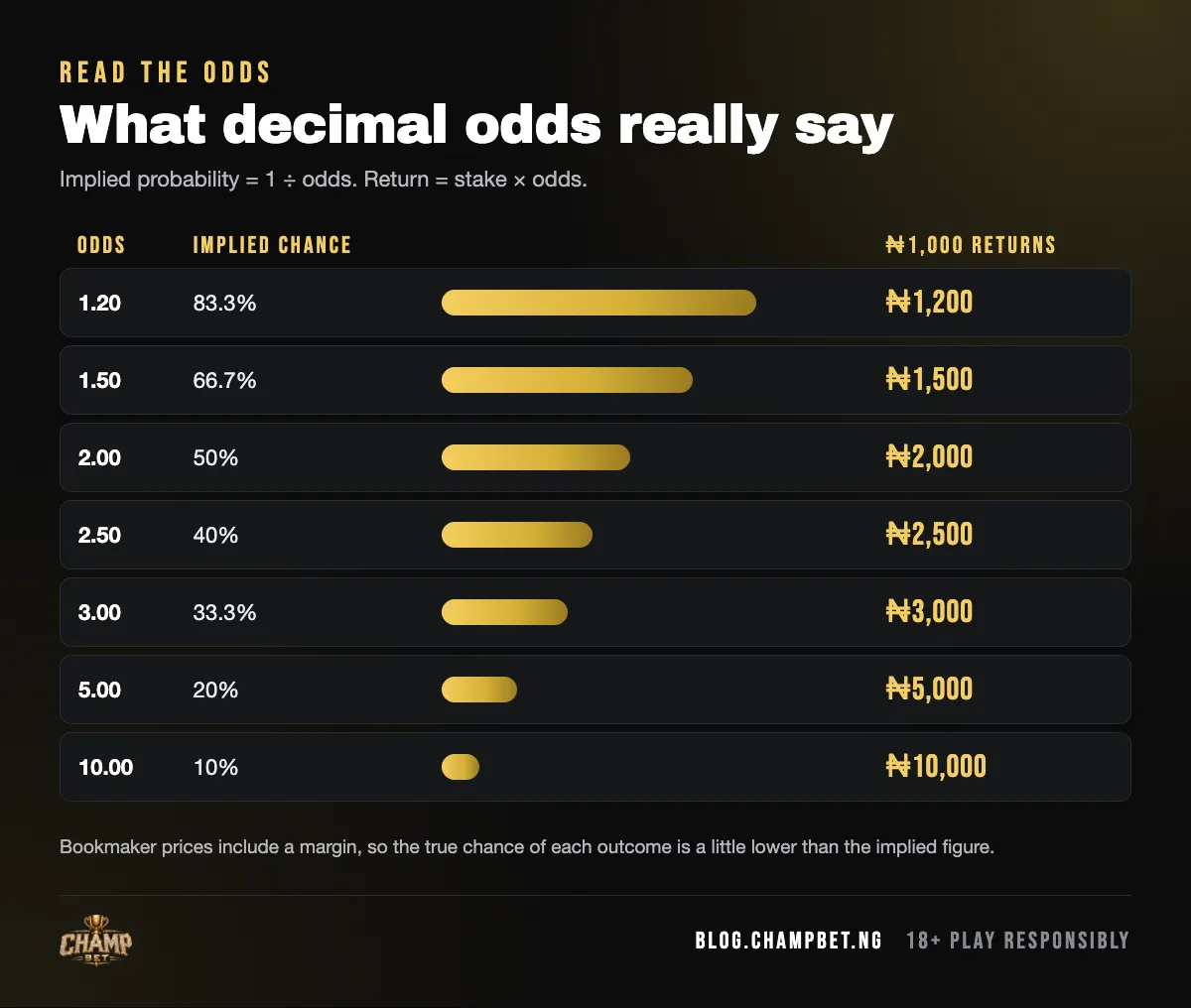
Implied probability is the chance of an outcome that the odds suggest. For decimal odds, divide 1 by the odds and multiply by 100. Odds of 2.00 imply 50%. Odds of 4.00 imply 25%. It turns a price into a percentage, so you can compare the bookmaker’s view with your own before you bet.
| Decimal odds | Implied probability | Return on ₦1,000 | Profit on ₦1,000 |
|---|---|---|---|
| 1.20 | 83.3% | ₦1,200 | ₦200 |
| 1.50 | 66.7% | ₦1,500 | ₦500 |
| 2.00 | 50.0% | ₦2,000 | ₦1,000 |
| 2.50 | 40.0% | ₦2,500 | ₦1,500 |
| 3.00 | 33.3% | ₦3,000 | ₦2,000 |
| 5.00 | 20.0% | ₦5,000 | ₦4,000 |
| 10.00 | 10.0% | ₦10,000 | ₦9,000 |
Two things to take from the table. First, payout and probability move in opposite directions: 10.00 pays ten times your stake because it is rated a one-in-ten shot. Second, the implied probability in a bookmaker’s odds is a little higher than the true chance, because of the margin explained below.
Using implied probability
If you think a team’s chance is higher than the implied probability, the price looks generous to you. If you think it is lower, the price looks short. That is all “value” means. It does not make a bet more likely to win. It tells you whether the price fits your view.
What is the bookmaker margin (overround)?
The bookmaker margin, also called the overround, is the edge built into the odds. Add up the implied probabilities of every outcome in a market and the total comes to more than 100%. The amount above 100% is the margin. It is why the odds you see pay slightly less than fair odds would.
Here is a simple 1X2 example:
| Outcome | Odds | Implied probability |
|---|---|---|
| Home win | 2.00 | 50.00% |
| Draw | 3.20 | 31.25% |
| Away win | 4.00 | 25.00% |
| Total | 106.25% |
The total is 106.25%, so the overround is 6.25%. Scale each probability down until the total is exactly 100%, and the fair odds would be 2.125 for the home win, 3.40 for the draw and 4.25 for the away win. The gap between those fair prices and the ones shown is how a bookmaker earns over time.
A lower overround means better prices for you. Margins vary from market to market, and you can run the same check on any market where you can see every outcome.
Why do betting odds change?
Betting odds change when the bookmaker’s view of an outcome changes, or when a lot of money comes in on one side. Team news, such as an injured striker, shifts the chances before kick-off. Heavy betting on one outcome pushes its price down. In live betting, goals, red cards and the clock move prices minute by minute.
The main drivers:
- Team news. Line-ups, injuries, suspensions and rotation all shift the chances.
- Weight of money. When many bets land on one side, its odds shorten and the other side’s odds drift out.
- Live play. In live betting, a goal, a red card or the time left changes every price. A level game late on usually sees the draw price shorten.
In fixed-odds betting, your bet is settled at the odds on your ticket when it was accepted, even if the price moves afterwards. ChampBet’s sports betting rules cover settlement in full. The one thing that does move with the market is a Cash Out offer, which tracks the current odds.
What about fractional and American odds?
Fractional and American odds are other ways of writing the same price, used mainly in the UK and the United States. Nigerian bookmakers use decimal odds, so you only need these when reading foreign media or tipsters. Each format converts to decimal in one quick step:
- Fractional to decimal: divide the top number by the bottom and add 1. 6/4 is 1.5 plus 1, so 2.50. Evens (1/1) is 2.00.
- American plus to decimal: divide by 100 and add 1. +150 becomes 2.50.
- American minus to decimal: divide 100 by the number and add 1. -200 becomes 1.50.
How odds work in accumulators and promotions
In an accumulator, the odds of each leg multiply, which is why small prices can add up to a big total. Our accumulator bets guide walks through a full example. To see which markets those odds belong to, read football betting markets explained.
Odds also decide whether a bet counts for some offers. Weekly Sports Cashback returns up to 6% of your weekly sportsbook loss as a free bet every Monday. It counts bets at odds of 1.30 or higher, needs a minimum weekly loss of ₦20,000, and the rate depends on your Champions Club level.
Putting it all together, our guide on how to bet on football in Nigeria walks you from account to first bet.
Put your odds knowledge to work
Open the ChampBet pre-match markets, pick a match and work out the implied probability of each 1X2 price before you bet. Add the three together and you will see the margin for yourself. Current offers are on the promotions page.
Frequently asked questions
How do you read betting odds?
In Nigeria odds are shown as decimals, such as 1.80 or 3.50. Multiply your stake by the odds to get your total return, including the stake. A ₦1,000 bet at 1.80 returns ₦1,800 if it wins. The higher the number, the bigger the payout and the less likely the outcome.
What does odds of 2.50 mean?
Odds of 2.50 mean a winning bet returns two and a half times your stake. A ₦1,000 stake returns ₦2,500, which is ₦1,500 profit plus your ₦1,000 back. The implied probability is 40%, because 1 divided by 2.50 equals 0.40.
How do you calculate implied probability from decimal odds?
Divide 1 by the decimal odds, then multiply by 100 to get a percentage. Odds of 2.00 imply a 50% chance, odds of 4.00 imply 25% and odds of 1.25 imply 80%. The figure includes the bookmaker margin, so it is slightly higher than the true chance.
Why do betting odds change before a match?
Odds change when the chances of an outcome change or when lots of money comes in on one side. Team news, injuries and line-ups move prices before kick-off. Once a match starts, goals, red cards and the time left move them again in live betting.