Responsible Gambling: Warning Signs, Tools and Free Help
Responsible gambling made practical: warning signs of a problem, budgets, time limits and breaks, ChampBet's policy and free gambling help in Nigeria.

In this guide
Responsible gambling means treating betting as paid entertainment: you set a budget and a time limit before you play, take breaks, never chase losses and stop when it is no longer fun. Most people who bet do it in moderation. For some, betting slowly takes over, and the earlier you spot the signs, the easier it is to change course.
This guide covers the warning signs, the practical tools that work, what ChampBet’s responsible gaming policy says and where to get free help in Nigeria and online. If you are worried right now, skip to where to get help.
What is responsible gambling?
Responsible gambling is betting in a way that stays fun and affordable. You decide in advance how much money and time to spend, you play only with money you can afford to lose, and you stop when you reach either limit. It never involves borrowing to bet, betting to fix money problems or chasing losses.
It is a shared job. You are in charge of your own decisions, and licensed operators must keep minors out, give clear information and act when a player shows signs of harm.
What are the signs of a gambling problem?
A gambling problem is betting that harms your life, work, finances or health, or that of your family, and that you find hard to stop. ChampBet’s responsible gaming page lists warning signs. It notes that only experts can diagnose a gambling disorder, and that five or more of these signs together point to a high chance of serious dependence:
- Gambling is on your mind most of the time.
- Your stakes have grown over time.
- Attempts to cut down or stop have not worked.
- You feel irritable or disappointed when you try to bet less.
- You gamble to escape problems or bad feelings.
- You try to win back money you have lost.
- You lie about how much you bet.
- You have done something illegal because of gambling.
- Gambling has damaged your relationships with family or colleagues.
- You borrow money to gamble.
A quick honest check
Ask yourself three questions. Have I bet money meant for rent, school fees, food or transport? Have I hidden my betting from people close to me? Do I feel I have to win back what I lost? If the answer to any of these is yes, it is worth talking to someone now, before things get harder.
Practical tools that keep betting under control
The tools that help most are simple and work before you place a bet, not after. ChampBet’s responsible gaming page sets out rules for playing without anxiety, and the steps below build on them.
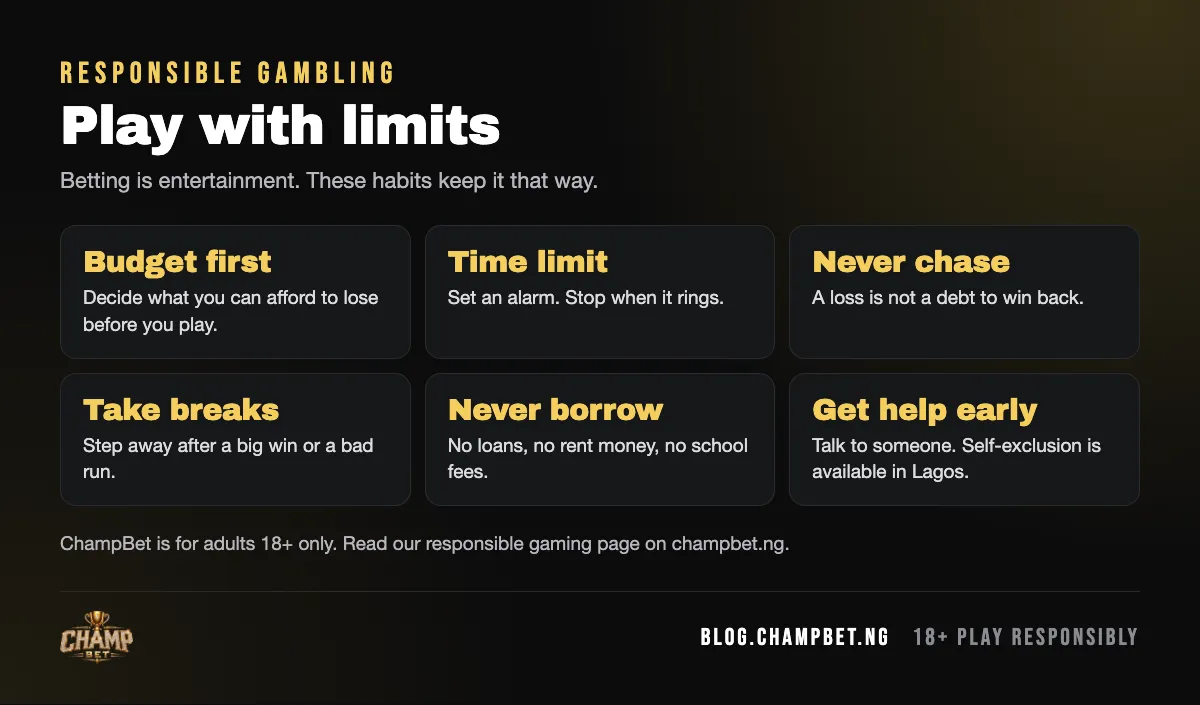
Set a budget before you play
Decide each month how much you can spend on betting, money you would be fine never seeing again. ChampBet’s rules say to set that amount in advance, decide what you can afford to lose and never raise the limit once you have set it.

A simple example: with a ₦20,000 monthly budget, stakes of 2% are ₦400 a bet. When the ₦20,000 is gone, betting stops until next month. Our bankroll management guide shows how to size stakes from a budget.
It also helps to set a stopping point for wins. ChampBet’s rules suggest deciding the amount of winnings at which you stop playing, so a good day stays a good day.
Set time limits
Decide how long a session lasts before you start, and set an alarm on your phone. Fast products such as live betting, virtual sports and crash games settle in minutes, so time can disappear quickly. A fixed number of bets or rounds is easier to keep than “just a few more”.
Take regular breaks
Step away from the screen often. A break gives you time to check your mood and your balance with a clear head. If you notice you are betting to win something back, that is the moment to stop for the day.
Play only in the right state of mind
ChampBet’s rules are clear: start playing only when you are calm and concentrated, and never under the influence of alcohol or drugs, or when you feel depressed. Betting after an argument, a bad day at work or a few drinks leads to decisions you would not make otherwise.
Make betting harder to reach
If cutting down is a struggle, add friction. Log out after every session, remove saved payment details, uninstall betting shortcuts and consider blocking software. Gambling Therapy has a guide on how to block gambling sites.
Self-exclude with SafePlay
Self-exclusion is a formal block on your own betting. In Lagos, SafePlay (safeplay.ng) is the self-exclusion registry the Lagos State Lotteries and Gaming Authority launched in August 2025. You register once with your NIN, choose a period from three months up to permanent, and SafePlay says enrolled licensed operators must then block your account and refuse your bets. It is free, and an exclusion cannot be cancelled before the period ends.
What does ChampBet’s responsible gaming policy say?
ChampBet’s responsible gaming policy rests on three principles: security of the player, security of the game and protection against gaming addiction. In short, it bars under-18s, protects personal data and payments, has the fairness and randomness of its products monitored by independent organisations and blocks access for players who cannot play safely.
The main points of the page:
- Minors are not allowed. Nobody under 18 can register or bet, and players must confirm their age and date of birth when they sign up.
- Parents are asked to help. The page asks you to keep your login details safe and recommends filter software on devices children use.
- Self-responsibility first. The final decision on whether to play, and how much to spend, belongs to you. ChampBet’s part is clear products, full information and a consistent line of conduct.
- Blocking for protection. Players with a gambling addiction are excluded from ChampBet’s games for their own protection, and are given contacts of organisations that offer professional advice and support.
- Honest marketing. ChampBet says its communication promises only what players can actually receive.
Several ChampBet promotion terms also say that self-excluded players, and accounts flagged for responsible gambling reasons, are not eligible for offers. If you want to talk about your account, contact ChampBet support on WhatsApp or live chat. Our ChampBet customer care guide lists the official channels.
Where can you get help for gambling in Nigeria?
Free, confidential help is available today, by phone or online. In Nigeria, Gamble Alert runs a 24/7 helpline and counselling. Online, Gambling Therapy offers free text chat with experienced advisers in more than 200 languages. In Lagos, SafePlay lets you self-exclude from licensed operators in one step.
| Service | What it offers | How to reach it |
|---|---|---|
| Gamble Alert (Nigeria) | Non-profit helpline, counselling and support for families | 24/7 helpline +234 916 295 7989, toll-free numbers on its website |
| Gambling Therapy (global) | Free text live chat with an adviser, peer support groups | gamblingtherapy.org |
| SafePlay (Lagos) | Self-exclusion from LSLGA-licensed operators | safeplay.ng |
Gamble Alert is an independent Nigerian non-profit that works on prevention, treatment support and underage gambling. GamCare, the UK support charity, lists it as the support contact for Nigeria.
Gambling Therapy, from the UK charity Gordon Moody, is a free, text-based service for anyone in the world. Its advisers support people in more than 200 languages, you can stay anonymous, and live one-to-one chat runs from 9am to 2am on weekdays and 10am to 10pm at weekends (UK time). Advisers can also help you find local counselling or groups, and the site hosts online peer support groups.
If you ever feel unsafe or think about harming yourself, go to the nearest hospital or contact emergency services straight away.
How do you talk to family about gambling?
Talking about gambling works best when it is calm, specific and free of blame. Choose a quiet moment, describe what you have seen and how it affects you, and listen. The aim is to open a door to help, not to win an argument.
If you are worried about someone else:
- Pick the right time. Not straight after a big loss or during a row.
- Be specific. “Money for the light bill went missing” lands better than “you are always betting”.
- Use “I” statements. “I am worried” invites a conversation. “You are an addict” ends it.
- Protect the household money. Separate accounts and do not lend money or pay off gambling debts, however hard that feels.
- Offer practical help. Suggest calling Gamble Alert together, or opening Gambling Therapy’s live chat.
- Look after yourself. Family members are affected too, and Gambling Therapy offers support for “affected others”.
If the person is your child, act early. Gamble Alert lists signs of underage gambling such as sudden changes in money, secrecy, poor school performance and a new focus on sports odds rather than the sport itself.
If you are the one who gambles, telling one trusted person is a strong first step. Saying it out loud often makes the next step easier.
Quick-fire games need the firmest limits: see our guides to Mines and Plinko fast games and Aviator predictor scams.
Keep it fun
Responsible gambling is about staying in control: a budget, a time limit, regular breaks and help when you need it. Read ChampBet’s responsible gaming page and the ChampBet FAQs, and if betting has stopped being fun, reach out to one of the services above today. You can also read whether betting is legal in Nigeria to understand how licensing protects you.
Frequently asked questions
What is responsible gambling?
Responsible gambling means betting only for fun, with money you can afford to lose, within limits you set before you start. It means taking breaks, never chasing losses and stopping when gambling stops being enjoyable. It also means operators keeping minors out and helping players who show signs of harm.
What are the signs of a gambling problem?
Common signs include thinking about gambling all the time, raising stakes over time, failing to cut down, feeling irritable when you try to stop, gambling to escape problems, chasing losses, lying about betting, borrowing to gamble and damaged relationships. Only a professional can diagnose a gambling disorder.
Where can I get gambling help in Nigeria?
Gamble Alert, a Nigerian non-profit, runs a 24/7 helpline on +234 916 295 7989 and offers counselling. Gambling Therapy offers free text chat with an experienced adviser in more than 200 languages. In Lagos you can also self-exclude from licensed betting sites through SafePlay, the LSLGA's self-exclusion registry.
How do I self-exclude from betting sites in Lagos?
Register on SafePlay at safeplay.ng, the self-exclusion registry launched by the Lagos State Lotteries and Gaming Authority in August 2025. You sign up once with your NIN, choose a period from three months to permanent, and SafePlay says enrolled licensed operators then block you. It cannot be cancelled early.
How can I help a family member who gambles too much?
Pick a calm moment, talk about specific things you have noticed and how they affect you, and avoid blame. Do not pay off their debts or lend them money. Offer to help them contact a service such as Gamble Alert, and get support for yourself too.