GG Tips: How to Pick Both Teams to Score (BTTS) Bets
GG tips for Nigerian bettors: the stats that matter for both teams to score, combining GG with over/under, when to avoid it and how GG works in accas.

In this guide
GG tips start with one simple idea: a both teams to score bet usually fails because the weaker attack does not score, not because the stronger one misses. So the best GG tips focus on whether both sides can realistically find the net, using scoring and clean sheet records, expected goals, team news and match context. This guide covers those factors, how to combine GG with over/under, when to avoid it and how GG fits into an acca.
Any odds shown are examples, not live prices.
What does GG mean in betting?
GG (goal goal) means both teams score at least once in the match. NG (no goal) means at least one team fails to score. It is the same market as Both Teams To Score (BTTS) Yes and No. The final result does not matter, and it is settled on 90 minutes plus stoppage time, so extra-time goals do not count.
For a full rundown of GG alongside 1X2, over/under and handicaps, see our football betting markets guide. Every market is settled under ChampBet’s sports betting rules.
How do you judge a GG bet?
Convert the odds into a probability and compare it with your own estimate. GG at 1.75 implies about 57%. NG at 2.05 implies about 49%. Those add up to about 106%, and the extra 6% is the bookmaker margin. Bet GG only when you rate the chance of both teams scoring above the implied figure, not just because both sides “like to attack”.
If you rate a match at 62% for GG, the fair price is about 1.61, so 1.75 is value. If you rate it at 52%, it is not. Our guide to how betting odds work shows the maths.
Which stats matter most for GG tips?
How often each team scores
Look at the share of matches in which each side has scored, split by home and away. A team that has failed to score in several recent away games is a GG risk on the road, however good its home record looks.
How often each team keeps clean sheets
Clean sheets are the other half of the story. A side that keeps a clean sheet in a large share of home games makes GG harder for any visitor. Official league stats pages, such as the Premier League’s club stats, show goals and clean sheets for every club.
The weaker attack decides it
Most GG bets live or die on the underdog. Ask one blunt question: where does the weaker team’s goal come from? A reliable striker, set pieces or a counter-attacking threat can answer it. If you cannot find an answer, NG may be the better side of the market.
Expected goals for and against
Expected goals (xG) rates the quality of every chance on a scale from zero to one. Two teams that both create decent chances (high xG for) and allow them (high xG against) are natural GG candidates, even if a recent result was 1-0. xG helps you see past lucky or unlucky scorelines.
Team news
A missing first-choice striker lowers a team’s chance of scoring. A missing goalkeeper or centre-back raises the opponent’s. Wait for confirmed line-ups if your bet depends on one player.
When should you avoid GG?
- A strong favourite against a weak attack. The favourite may score three, but if the underdog rarely creates chances, NG lands.
- Low-scoring leagues. The 2025/26 NPFL averaged 2.0 goals a game, and away wins were rare. That is harder ground for GG than a league averaging close to three goals. Our NPFL betting guide explains why.
- Cagey knockout legs. A team protecting a first-leg lead may defend deep and accept a 0-0 or 1-0.
- Bad weather and poor pitches. Heavy rain or a bumpy surface cuts the number of clear chances.
- Motivation gaps. A side with nothing to play for may not push for a consolation goal.
How do you combine GG with over/under?
GG and over/under answer different questions, so combining them sharpens your read. Here is how common scorelines settle:
| Final score | GG | Over 2.5 | GG and Over 2.5 | GG and Under 3.5 |
|---|---|---|---|---|
| 0-0 | No | No | No | No |
| 1-0 | No | No | No | No |
| 1-1 | Yes | No | No | Yes |
| 2-0 | No | No | No | No |
| 2-1 | Yes | Yes | Yes | Yes |
| 3-0 | No | Yes | No | No |
| 2-2 | Yes | Yes | Yes | No |
| 3-1 | Yes | Yes | Yes | No |
- GG and Over 2.5 suits open games you expect to finish 2-1, 2-2 or 3-1. It loses on 1-1.
- GG and Under 3.5 suits tight games where both sides score once or twice: 1-1, 2-1 or 1-2.
- NG and Under 2.5 suits a strong defence facing a blunt attack: 1-0, 2-0 or 0-0.
To combine markets from the same match on ChampBet, use Bet Builder: tap the BB icon on the event. Combined picks pay more because both parts must land. For more on goal lines, read our over 2.5 goals tips.
GG in accumulators
GG legs are popular in accas because each one looks likely. The maths says otherwise. Five GG legs at 1.70 give odds of about 14.20. If each has a 58% chance, all five land only about 7% of the time. Keep GG accas to two or three researched legs, or play your strongest GG picks as singles. Our guide to accumulator bets explained shows why each leg cuts your chances.
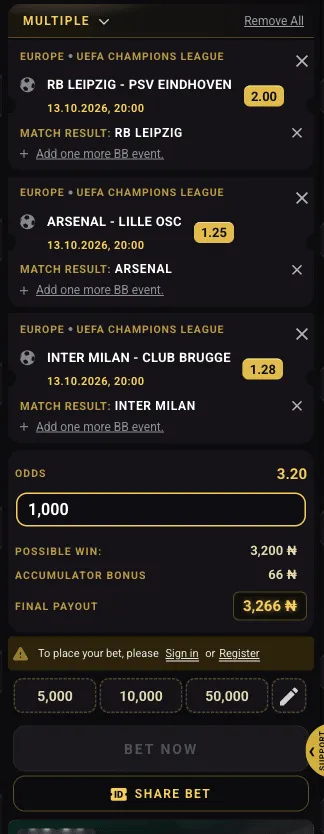 The ChampBet slip shows the combined odds, possible win and an automatic accumulator bonus on qualifying multiples.
If you do build a longer acca, ChampBet’s One Leg Down offer can help. On accas of four or more selections at 1.40 or higher, with a minimum stake of ₦1,000, if exactly one selection loses you get a free bet based on the number of legs: 20% of your stake with four legs, 40% with five. A ₦2,000 five-leg acca with one losing GG leg would return an ₦800 free bet. Bet Builder bets do not qualify, and selections from the same match count as one. Full terms apply.
Live GG: when one team scores first
Once one team scores, GG only needs the other to reply, so its price shortens. Two situations are worth watching if you are following the game:
- The underdog scores first. The favourite usually pushes forward, which can make an equaliser likely. GG may still be fair value at that point.
- The favourite scores early and keeps the ball. If the underdog is creating nothing, a shorter GG price can be a trap. Look for real chances before you back the reply.
Only bet live on games you can watch, and consider Cash Out if the match turns against you. ChampBet’s live betting page carries in-play GG and totals markets.
A quick GG checklist
- Check how often both teams score, home and away.
- Check how often each keeps a clean sheet.
- Find the weaker team’s route to goal.
- Look at xG for and against.
- Read confirmed team news and the conditions.
- Compare your estimate with the implied probability before you bet.
Our GG angles for this round are in the Premier League predictions this weekend.
Find GG markets on ChampBet
Open any football match in the ChampBet sportsbook to find GG/NG alongside the 1X2, handicap and totals markets. For the bigger picture on staking, team news and accas, read our football betting tips.
Frequently asked questions
What does GG mean in betting?
GG means both teams score at least one goal in the match. NG means at least one team fails to score. They are the Nigerian names for Both Teams To Score Yes and No. The result does not matter: 1-1, 2-1 and 3-2 are all GG, while 1-0 and 3-0 are NG.
What is the difference between GG and over 2.5?
GG needs each team to score once. Over 2.5 needs three goals from anyone. A 1-1 draw wins GG but loses Over 2.5, while a 3-0 win is Over 2.5 but NG. If you expect a tight game where both sides score, GG fits better than Over 2.5.
Is GG a good bet in accumulators?
Only in small numbers. Each GG leg is often not much better than a coin flip, so the chances fall fast as you add legs. Five GG legs at 1.70 pay about 14 times your stake, but if each has a 58% chance, all five land only about 7% of the time.
When should I avoid a GG bet?
Avoid GG when a strong favourite faces a side that rarely scores, in low-scoring leagues, in cagey knockout games where one team protects a lead, and in heavy rain or on poor pitches. In each case, one team failing to score is more likely than the odds may suggest.